Biography
Nazlı Efe is a New York–based interdisciplinary artist of Turkish and Cypriot descent, working across installation, sculpture, and performance. Her practice explores themes of Water, memory, and the unconscious.
Efe studied Architecture at Bahçeşehir University in Istanbul and Virginia Tech in Washington, DC. After five years in the creative industries, she earned her MFA with High Honors from Pratt Institute in 2022.
Her work has been exhibited at the Bronx Museum, RAINRAIN Gallery, the Sotheby's Institute of Art, and Monira Foundation, and featured in the New York Times, Hyperallergic, and Whitehot Magazine. She is the recipient of the Stutzman Family Foundation Sculpture Award Special Recognition, and the Pratt Outstanding Merit Award, and has been nominated for the Rema Hort Mann Foundation Emerging Artist Award.
Efe has participated in residencies and fellowships, including the Bronx Museum AIM Fellowship, ProjectArt Teaching Artist Residency, and Pratt>Forward. She teaches at Pratt Institute's K–12 Center and leads workshops at organizations such as the Textile Arts Center and Powerhouse Arts. Nazli has been a Member Artist at the Elizabeth Foundation for the Arts Studio Program in New York since 2022.
Statement
Being half Turkish—a country surrounded by Water on three sides—and half Cypriot, from an island in the Mediterranean, I grew up in constant connection with Water.
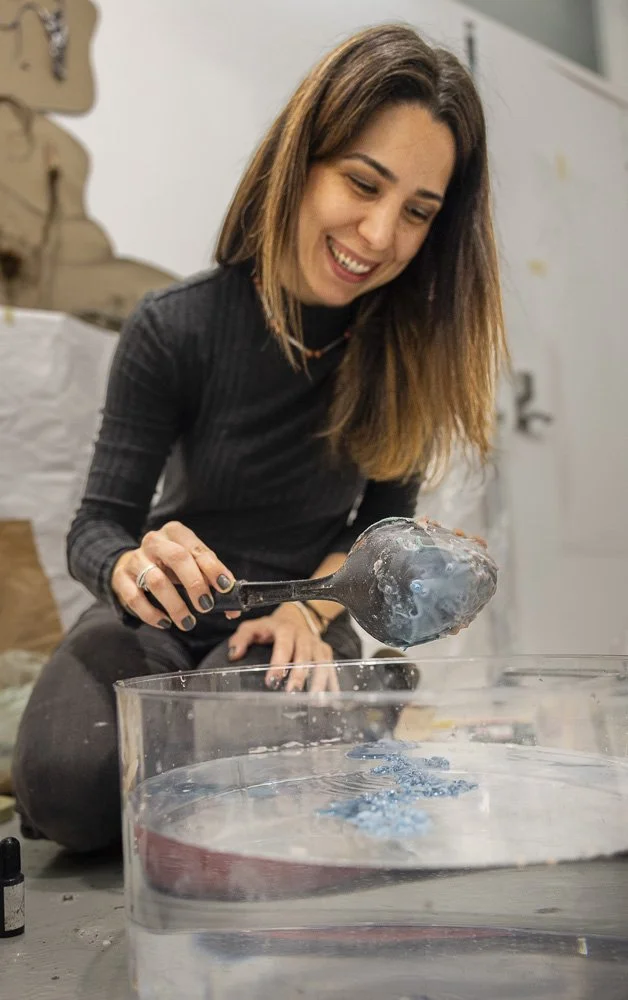
Water is a ritualistic, meditative, and performative medium through which I access my unconscious mind and manifest the emotional presence of memory in my installations and sculptures.
I’m deeply influenced by molybdomancy (kurşun dökme), a centuries-old divination practice in Turkey where molten lead is dropped into Water and the resulting shapes are interpreted. In my recent studies, I’ve adapted this ritual by working with molten wax instead. When the wax meets Water, it forms amorphous shapes similar to the Rorschach test. These forms become artifacts of my memories and emotions rising to the surface. Together with found objects, wax forms construct the material language of my installations.
In my latest body of work, I’ve been focusing on preserving my recollections. I draw from medical and culinary practices, using materials and methods like gauze, salt, vacuum sealing, and wax-coating. These choices inherit themes of conservation, healing, and ritual care.
My work exists at the intersection of the material and immaterial, the permanent and the ephemeral. Through transforming materials in an alchemical way, I engage with the ever-changing nature of memory. Memory follows form, and form follows memory.
Photo credit: Steve Riskind